The World of Natali and Baudouin: Sylvael, Moonroot and the Heart Tree
A guide to the world of Natali and Baudouin: the elven kingdom of Sylvael, Moonroot Academy, the Heart Tree ritual, blue healing light and the orcs of Khazreth.
Natali and Baudouin is a vertical romantasy series told in short daily parts, and much of its charm comes from the world around the two lovers. This guide walks through the places, the magic and the customs of the story as they have been revealed in the released episodes, from Part 1 to Part 21. It contains light spoilers for those parts, but nothing beyond them.
Sylvael, the kingdom of the High Elves
Sylvael is an elven kingdom hidden inside an enchanted forest. The trees here are giants, their roots covered with glowing moss; fireflies drift between the trunks even in daylight, and golden beams of sun cut through the canopy. Streams run between the ferns, and wild creatures live in the quiet glades. It is in such a glade that we first meet Natali in Part 1, kneeling beside a wounded doe whose leg is caught in thorny vines.
The royal palace of Sylvael is not built so much as grown: it rises out of the trunks of ancient trees. Its heart is the throne room, where the King sits on a throne of living branches. This hall is where the most important and painful conversations of the story happen. In Part 7 the King forbids his daughter to think of a commoner, in Part 12 Aelarion proposes to Natali in front of the whole court, and in Part 17 the King tries to bend the will of the Heart Tree itself. Natali’s candlelit chambers are kept for quieter scenes with her mother and Lyrelle.
Everyone in Sylvael is an elf, from the royal family to the students and guards in the background, and every one of them has the long pointed ears of their people. There are no humans in this world.
Moonroot Academy
Moonroot Academy is the school of elven magic where Natali begins her studies in Part 2. Its white towers are formed from enormous living trees. The central courtyard holds a stone circle for duels, where students train with practice blades under the watchful eye of Master Eldrin. That circle is the setting for one of the most memorable scenes of the first episodes: the duel between Baudouin and Aelarion in Part 5, fought to the first touch.
Lessons take place in a rotunda beneath a living tree. In Part 3 Eldrin asks his students to bring a withered flower back to life, and Natali accidentally makes the whole hall bloom. The Academy also has a spiral library, where in Part 11 Eldrin draws a glowing image of the Heart Tree in the air and explains the ritual of choosing. There are galleries above the courtyard, where secrets are overheard, dark stone corridors lit by torches, and Eldrin’s candlelit study, where the old mage speaks to Baudouin in Part 15.
The Academy accepts both nobles and commoners. Baudouin, a forester’s son, earned his place by talent alone, which is exactly why Aelarion and his friends never let him forget where he came from.
The Glowing Lake
Next to the Academy lies the Glowing Lake, a place of fireflies, soft light on the water and pebbled shores. It is the story’s place of honesty. In Part 8 Natali slips out at midnight after finding a note that reads only “The lake. Midnight. — B.”, and in Part 13 the two of them return there for the confession that gives that episode its title.
Magic: the blue healing light
Magic in Sylvael has clear colours, and the series uses them like a visual language. Natali’s gift is a soft blue light with sparks that gathers around her palms. With it she frees the doe in Part 1, heals the cut on Baudouin’s arm after the duel in Part 5 and closes a young guard’s wound at the forest border in Part 9. Her power is unusually strong. When she tries to revive a single flower, the entire hall bursts into bloom and the crystal on Eldrin’s staff fires a beam into the dome.
Eldrin teaches that “Magic is not strength. It is listening.” He also warns Natali that such power draws attention, and the story proves him right almost immediately. Natali’s guiding principle is simple: a healer heals whoever is hurt. She does not stop to ask whether the wounded belong to her side.
Warm emerald belongs to the forest, the Heart Tree and its bracelets. A poisonous, toxic green belongs to something very different, as we see below.
The Heart Tree and the ritual of choosing
The Heart Tree is the most sacred thing in Sylvael. It stands in a glade ringed with rune stones, its roots glowing a warm emerald and golden leaves falling around it. Its will is sacred, and not even the King can overrule it. As Eldrin puts it in Part 11: “At twenty-one, the Tree chooses. Its will is sacred.”
Once a year, elves who have turned twenty-one gather before the Tree. Its glowing roots reach out to two of them, wind around their wrists and become matching wooden bracelets set with emeralds. Every couple receives its own pattern, and the bond is meant to last: “Two hearts. One bond. Bracelets no one can break.” In Part 20 we finally see the ritual itself, with the whole court standing in a ring behind the stones, couples being chosen one by one, and the roots staying perfectly still for Lyrelle.
The ritual sits at the centre of the story’s conflict. The King wants Natali to marry Aelarion, but the law, as he admits himself, is one: the Tree decides. That is why Aelarion tries to make sure his rival does not come, and why the King asks Eldrin to “guide” the Tree, only to hear that “The Tree cannot be bought.” When the moment arrives in Part 21, the roots pass Aelarion by and run on to Baudouin. The bracelets grow on both of their wrists, Eldrin declares that the Tree has chosen, and the King answers with a single word.
Khazreth and the Gates of Worlds
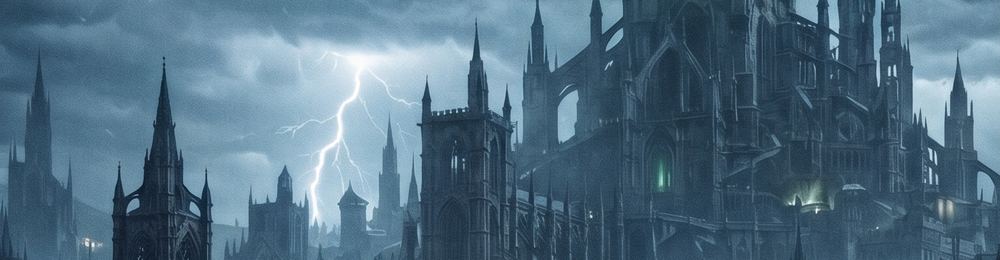
Far from the golden forest lies Khazreth, the kingdom of the orcs. It is a gothic stone city of spires and bridges under an eternal thunderstorm, lit by lightning and by a poisonous green glow in its towers. At its heart is the hall of the Gates of Worlds, a pulsing green portal. The very first scene of the series, in Part 1, takes place here: Morn, the chieftain of the orcs, kneels by the stretchers of his wounded warriors. Green veins creep along the arm of a young orc, and Morn admits that his healers are useless. “Find me a healer. Whatever it costs.”
The orcs of this world are not mindless monsters. They have strong tusked faces, green skin and a proud, almost noble bearing, and their leaders have their own fears and rivalries. In Part 10 we meet Morn’s court: the treasurer Dimeon Tsur’in, who claims another’s discovery as his own, and Morn’s son Karrek, the only one who sees through the lie. By Part 11 a column of orcs with torches is already marching across the bridge toward the forest. Why the orcs’ wounds refuse to heal, and what the green breath of the Gates has to do with it, is one of the mysteries the series is still keeping.
Beyond the Veil: why nobody dies
Natali and Baudouin promises real danger but no deaths. In this world the defeated are not killed; they are banished beyond the Veil, into another reality, through the Gates of Worlds. Eldrin almost lets this slip during his lesson in Part 11, starting to speak of “those sent beyond the Veil” before closing the scroll with the words “Some doors should stay closed.” The rule keeps the tone warm even at the darkest moments.
Where to start
The best way to explore this world is to watch it unfold in order, starting from Part 1: Find Me a Healer. Each part is about a minute long, and new episodes appear here and on our YouTube channel, @nataliproductionfun. If you would like to know more about the people of Sylvael and Khazreth, read our guide to the characters of Natali and Baudouin.